view in the browser · subscribe via email or rss
By way of a greetingWelcome friends. You're receiving this communication because at some point you came across my music work on Bandcamp and/or have personally subscribed with your email address to this newsletter. If that is the case, thank you for your support and your attention. Knowing that you are out there sustains me with an ever greater fervor to create and share. In the wake of spiraling algorithmic context collapse and escalatingly oblique methods of control and interference deployed in centralized social media contexts, I've decided to make an effort to craft a personal newsletter that offers a more fulfilling insight into my praxis, my thoughts on creative endeavor, updates on recent activities, and living a creative life. An important motivating factor was to make the newsletter self-hosted using an open-source and privacy-aware tech stack, allowing me to extricate myself (and my subscribers' data) from yet another rent-seeking zombie service provider that overcharges and overexerts its influence on this fragile but crucial thing we call communication with one another. The infrastructure is built now, which means that there won't be any intermediary third-party between myself and your inbox: no tracking; no selling of your information. Just direct transmissions from me to you. Intention behind the newsletterNewsletter dispatches flow in numbered Issues, and aim to cover an assemblage of my recent music projects, performances, and upcoming engagements, with the occasional musing or announcement intertwined. If you would like to opt-out of receiving future issues of this newsletter, you can unsubscribe at the bottom of this message. \(´༎ຶ‿‿´༎ຶ)/ Current moodAs a reprieve from the hyper-extended and metabolic media-induced attention scattering mindset, given the velocity of information in our contemporary moment, I've been finding new purpose and excitement in instrumental practice, journalling with pen and paper, and reading old books … away from the screen, away from notifications, and away from their concomitant levels of reduced focus. The more I settle into this calm, concentrated work, my listening improves, my technique continues to deepen and grow, and my imagination feels reinforced and activated. New recordings, a New York premiere, jazz sextets, a continued obsession with the pianists and composers who haunt me, the Subvert Co-op, and OperaFest LA. 1416 m³ · Dia Art Foundation
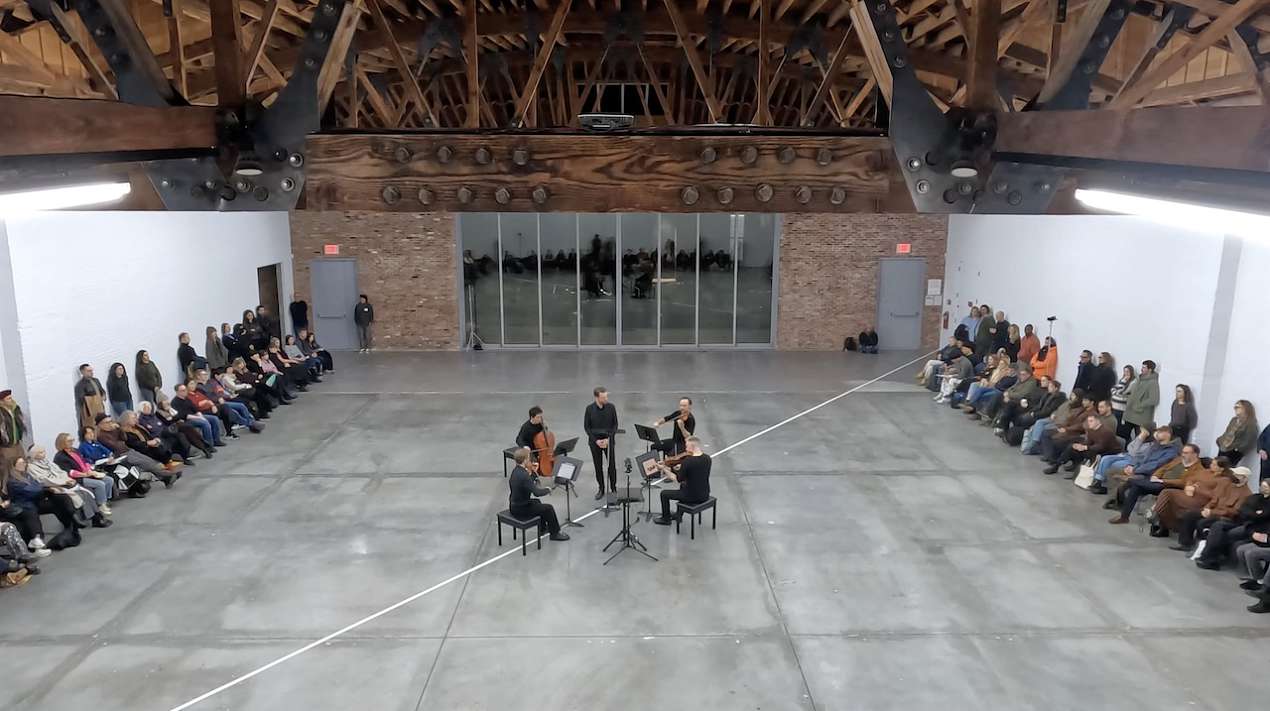
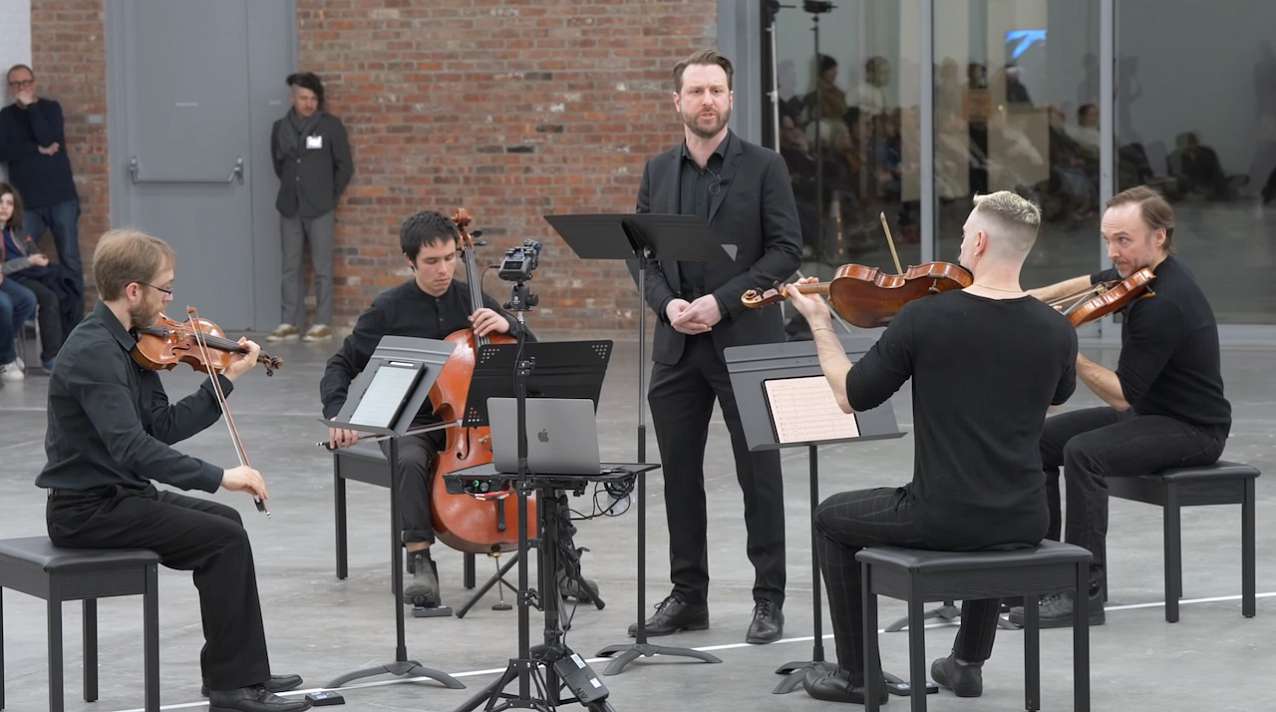
→ YouTube On February 10, the JACK Quartet and baritone Jesse Blumberg gave an extraordinary performance for the New York premiere of 1416 m³ at Dia Chelsea. It is a string quartet that I composed following a concept by Argentinian conceptual artist David Lamelas, originally commissioned for the Oberlichtsaal at Kunsthalle Basel, where the gallery's volume became the score's organizing principle: each cubic meter of space filled with sound, the architecture itself dictating duration, density, pitch, register. This performance functioned as a prelude to David Lamelas: The Machine, which opened on March 6, co-organized by Dia Art Foundation and the Institute for Studies on Latin American Art (ISLAA).
What compelled me about Lamelas' framework was its insistence that a room is never neutral: to measure a space is an act of interpretation and intervention, and I aimed to honor David's interrogations of time (which are the through line of his artistic output) by making the music feel less like something performed inside the gallery than something the gallery was slowly exhaling. I also want to highlight the intensity with which the JACK Quartet's and Jesse's listening abilities struck me. Given their proclivities to microtonal repertoire, this deep capacity for listening induced such an incredible impression that it seemed as though that all the instrumentalists' and vocalist's parts, combined with the acoustics of the space, gelled into a single, coherent mass of sonic texture, expertly controlled. It was an honor to work with these musicians and with Dia's Deputy Director of Program Humberto Moro, Manager of Exhibitions Alexis Pennington-Foster, Curatorial Assistant Ella den Elzen, and the rest of their team to reactivate 1416 m³ at such a high level. Max Jaffe · You Want That Too!
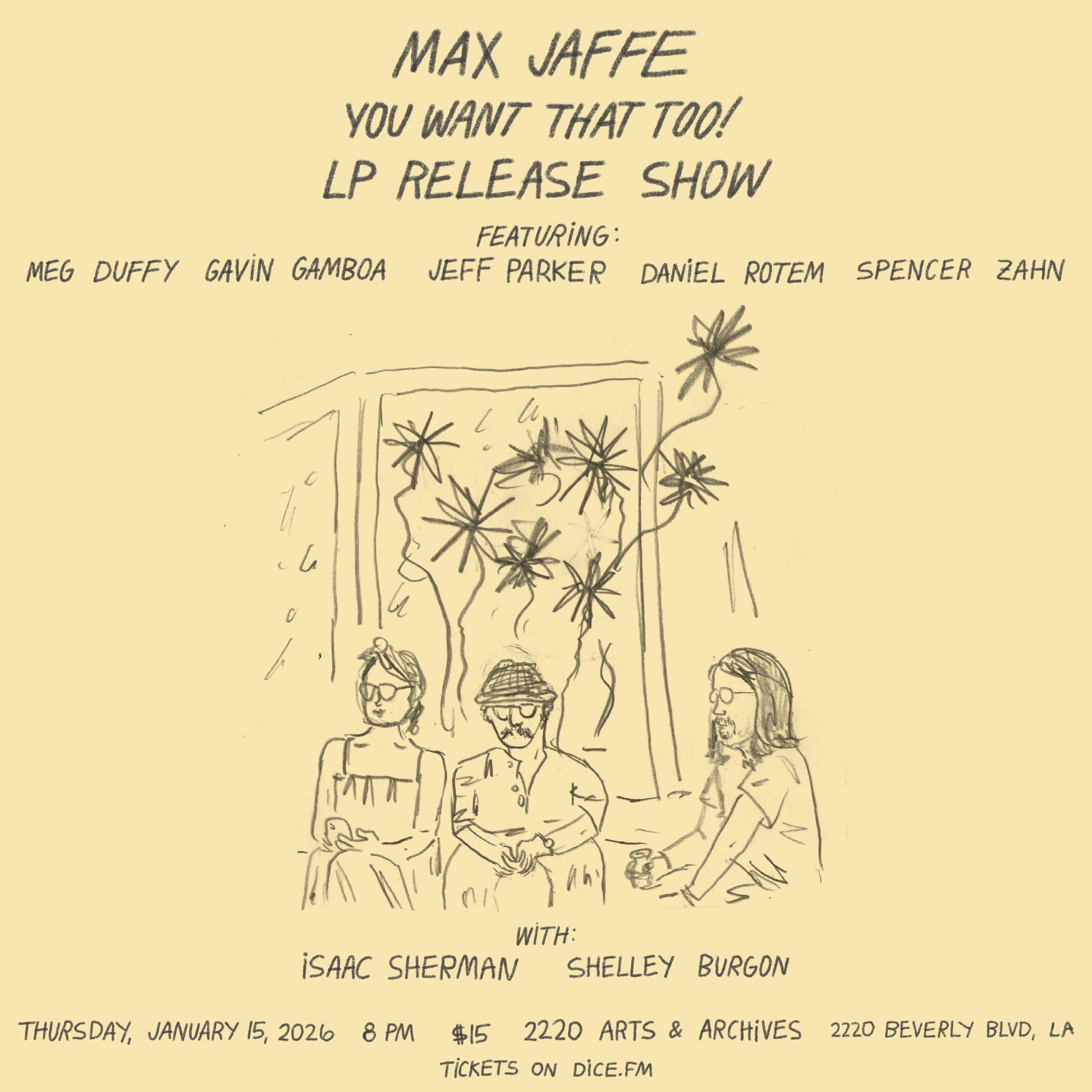
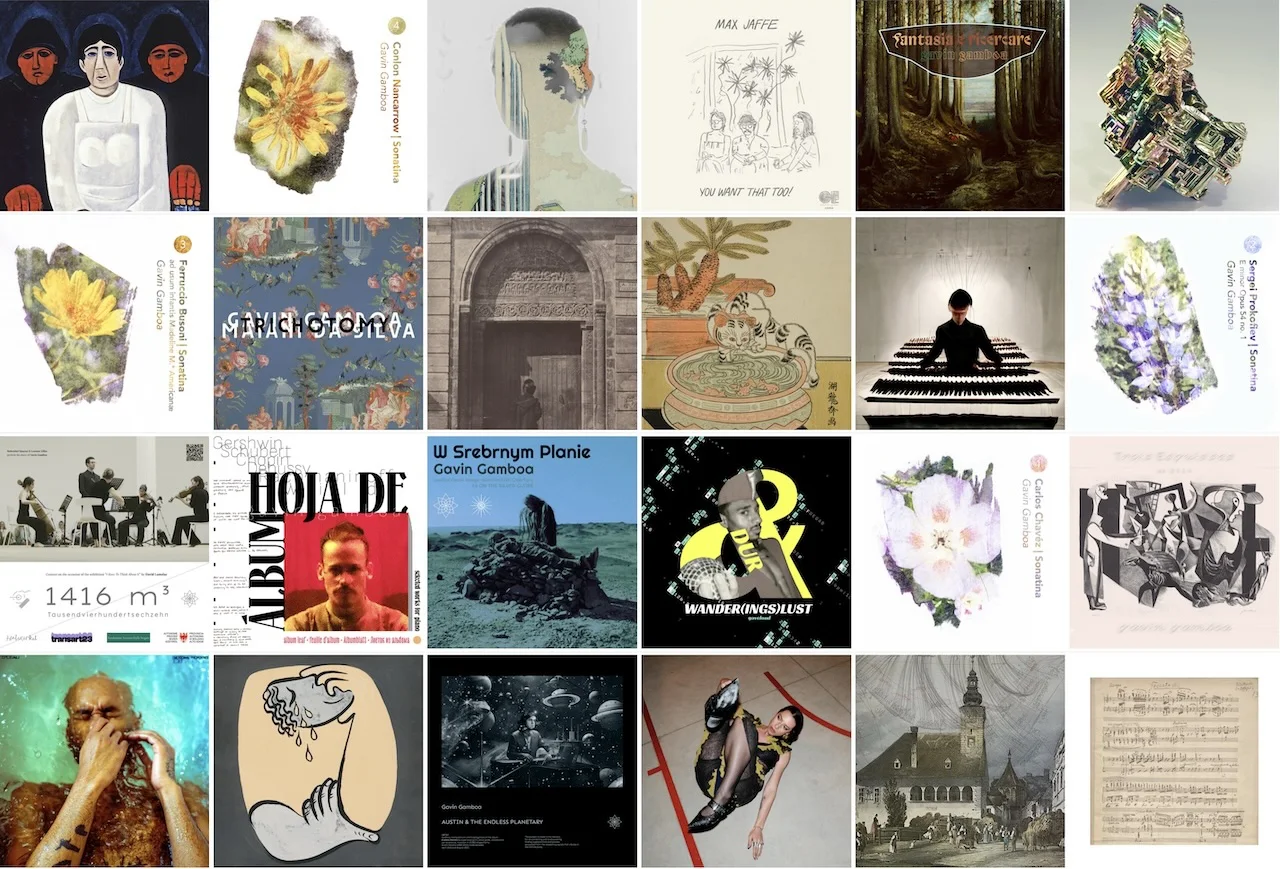
On January 15 at 2220 Arts + Archives we celebrated the release of Max Jaffe's You Want That Too! on Colorfield Records produced by Pete Min. I loved how this particular ensemble held the space between restraint and overflow, something Max has always understood as an expressive rather than a structural question. The sextet featured Meg Duffy on electric and MIDI guitar, Jeff Parker on electric guitar, Daniel Rotem on tenor saxophone, Spencer Zahn on fretless electric bass, and myself on piano and synthesizers, a combination of timbres that should, by any reasonable measure, create chaos, and instead created something more akin to weather. Tracks on the record that I am featured on include: Gulf Of Mexico, Looking At The Inside Of Your Eyelids, and Ancestral Creeks. Made at Lucy's Meat Market in Eagle Rock, it's one of the best-sounding projects I've had the privilege of being a part of. The poster and album art for You Want That Too! is by the ever-whimsical and talented Sara McGrath. Negrón ⎮ Eisler
This is a pairing I've been sitting with for years, recorded across two separate sessions in Los Angeles: Hanns Eisler's Klavierstücke Opus 8 in May of 2016, and Angélica Negrón's La Intervención for solo piano in June 2021. The conceptual logic that drew these two composers together for me is something like a shared grammar of displacement. Both are embedded in film-music; both navigate the friction between colloquial idiom and rigorous formal intent; both write from positions of political exposure. Eisler was deported from LaGuardia in March 1948, blacklisted by the House Committee on Un-American Activities, and his statement upon leaving:
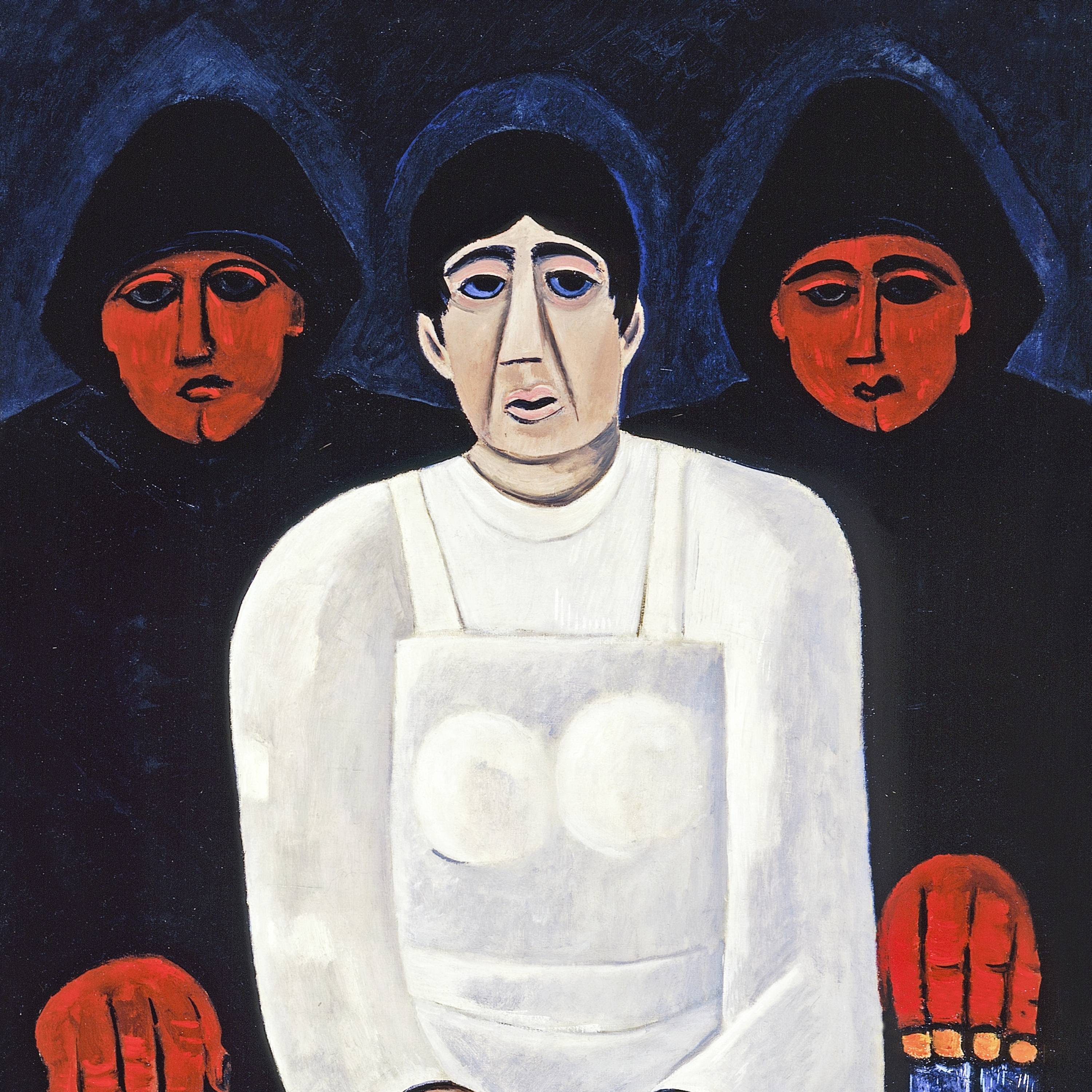
… resonates with an almost unbearable precision in the current political climate, and against Negrón's work, which maps its own kind of intervention across a very different hemispheric inheritance. The cover art is a detail from Marsden Hartley's The Lost Felice, 1939. Conlon Nancarrow ⎮ Sonatina
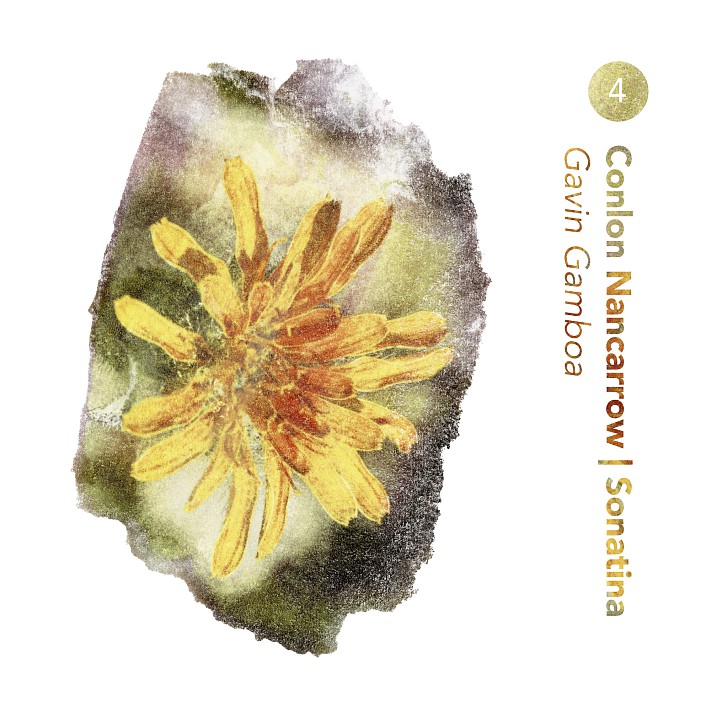
→ Bandcamp → Subvert → Mirlo → YouTube Released in January, this recording is my attempt at sitting with Nancarrow on acoustic piano … away from player pianos, away from the automated impossibility he's most famous for. The Sonatina is compact, irreverent, and full of hidden rhythmic traps. I've wanted to record it for years. It is the first piece Nancarrow composed after arriving in exile in Mexico City in 1941, and it carries within it the seeds of the impasse he would soon reach: music whose demands on a human performer were so extreme, so fantastically imagined, that the player piano became not a retreat but an expansion, a way of thinking rhythmically beyond the body's negotiable limits. Playing it as a human pianist means you are continually bridging the audible gap between intention and realization, and I find that tension not only challenging but genuinely illuminating about what notation asks of us. The great Hungarian composer György Ligeti had this to say about Nancarrow:
As before, the Sonatina Series artwork is designed by my dear friend, the brilliant visual artist Ted Nava. Trichotomy · with Maiani da Silva
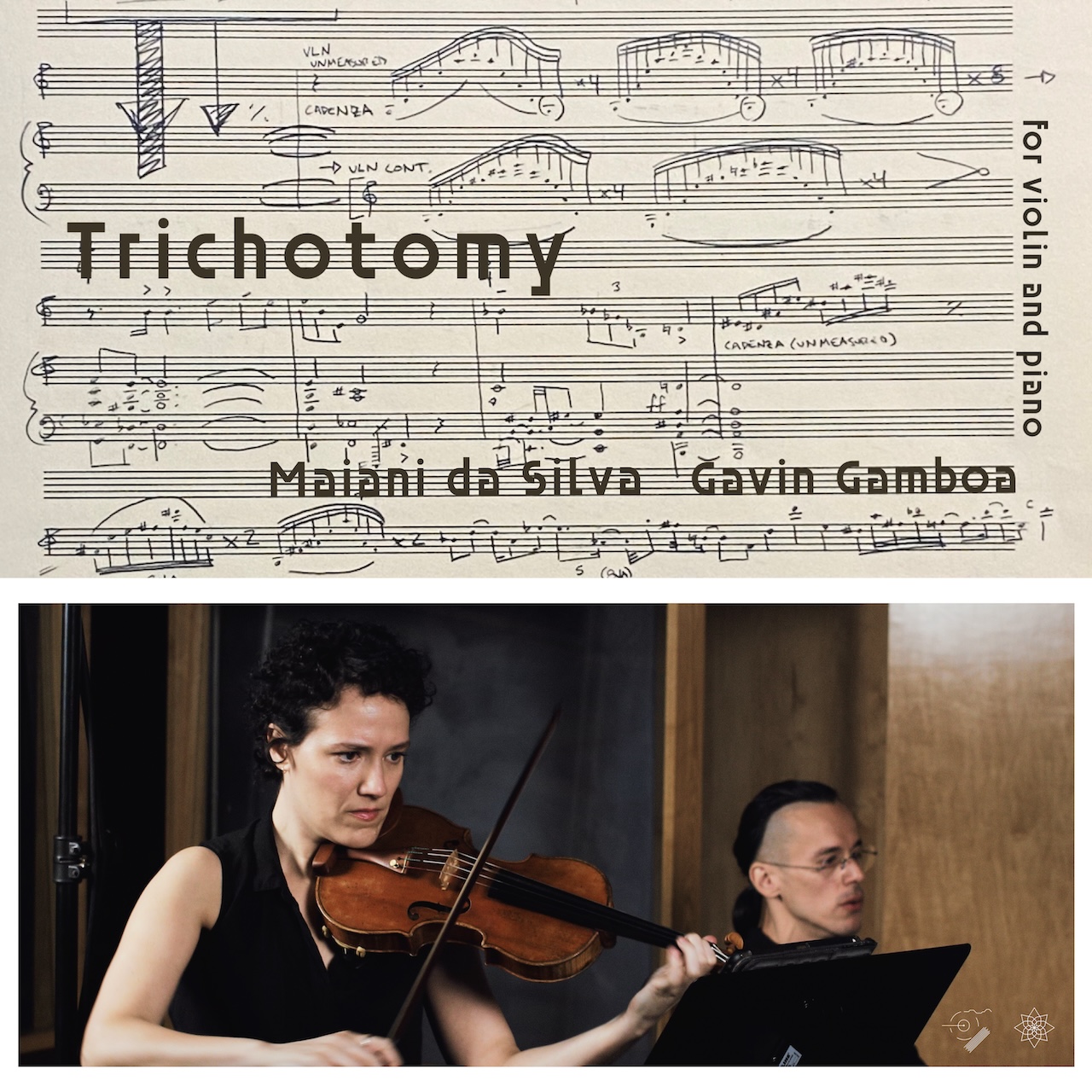
→ Bandcamp → Subvert → Mirlo → YouTube Trichotomy is a three movement work for violin and piano which takes as its point of departure something of an amalgamation of the works by composers Leos Janáček, Arnold Schoenberg, and Claude Debussy. But of course … I'll let you draw your own conclusions on this extremely subjective matter :) The piece has been brought to life in collaboration with Maiani da Silva, a supremely gifted violinist who is currently a member of the chamber ensemble Eighth Blackbird, and Recording Engineer Lewis Pesacov, a multi Grammy Award nominated producer in the Classical Compendium and Opera categories. This is one of the most gorgeously-captured and exquisitely played records I have ever put out into the world, and I am immensely indebted to the features and instincts that both Maiani and Lewis lent to this recording. Louis Ng deserves a special thanks as well, for capturing and assembling the video recording we made of the session. It is available on YouTube and I am very grateful for Louis' deftly handled quality and care in putting it together. Reliquie
|